<?xml version="1.0" encoding="utf-8"?>
<feed xmlns="http://www.w3.org/2005/Atom">
  
    <title type="text" xml:lang="en">James Shaw | iOS Developer | iPhone, iPad, Apple Watch</title>
    <link type="application/atom+xml" rel="self" href="http://shaw-james.com/atom.xml"/>
  
  <link href="http://shaw-james.com/"/>
  <id>http://shaw-james.com/</id>
  <updated>2024-03-08T20:56:31Z</updated>
  <author>
    <name>James Shaw</name>
    <email></email>
  </author>
  <rights type="text">Copyright © 2024 James Shaw. All rights reserved.</rights>
  
  <entry>
  <title type="text">Xcode Tips and Tricks - Using Sourcery for Project Secrets</title>
  <link rel="alternate" type="text/html" href="http://shaw-james.com/using-sourcery-to-handle-secrets-and-environment-variables-in-xcode.html" />
  <id>http://shaw-james.com/using-sourcery-to-handle-secrets-and-environment-variables-in-xcode</id>
  <published>2021-08-22T00:00:00Z</published>
  <updated>2021-08-22T00:00:00Z</updated>
  <content type="html"><![CDATA[ <p><img src="assets/images/xcode_sourcery.jpg" alt="Xcode 12 - Sourcery" /></p>

<h2>⁉️ The Problem</h2>
<hr />

<p>Environment Variables (or Project Secrets) are present in the vast majority of software projects. Whether they be <strong>API Keys, Passwords, Tokens</strong> or other sensitive information; they should <strong>never</strong> be pushed to an unencrypted remote repository. That being said, all too often, this is not the case and sensitive information finds its way into unencrypted repos. 😬</p>

<p>This is a big problem, particularly when we start to think about CI/CD pipelines too. 🤔 However, fear not! In this blog post, we'll look at this problem in an Xcode specific context and how we can avoid sensitive information being checked into source control.</p>

<h2>✅ The Solution</h2>
<hr />

<p>Our goal here is to pass the environment variables into our project at build time; and then for our build process to generate a <code class="language-plaintext highlighter-rouge">.swift</code> file containing our secrets that can be used within the codebase. The solution has 3 main steps; <strong>Bash Script</strong>, <strong>Xcode Injection</strong> and <strong>Swift codegen</strong>. Lets look at each step in turn.</p>

<h4>1. 🔨 Bash Script</h4>
<hr />

<p>First let’s create a file named <code class="language-plaintext highlighter-rouge">env-vars.sh</code> which contains the environment variables we need to use in our project. For example:</p>
<div class="spacer-code-block" />

<div class="language-plaintext highlighter-rouge"><div class="highlight"><pre class="highlight"><code>export EXAMPLE_API_KEY=ABCDEF123456
export EXAMPLE_PASSWORD=PASSWORD
</code></pre></div></div>

<p class="figure"><i>Example env-vars file.</i></p>

<p>We’ll add this into the root directory of our Xcode project and also add it to our <code class="language-plaintext highlighter-rouge">.gitignore</code> to avoid the file being committed to source control.</p>

<h4>2. 💉 Xcode Injection</h4>
<hr />

<p>Once we’ve created our <code class="language-plaintext highlighter-rouge">env-vars.sh</code> file, we need to make these variables available to Xcode and our Swift code. To do this, we’ll use a combination of build run scripts and a Swift codegen tool called <a href="https://github.com/krzysztofzablocki/Sourcery">Sourcery</a>.</p>

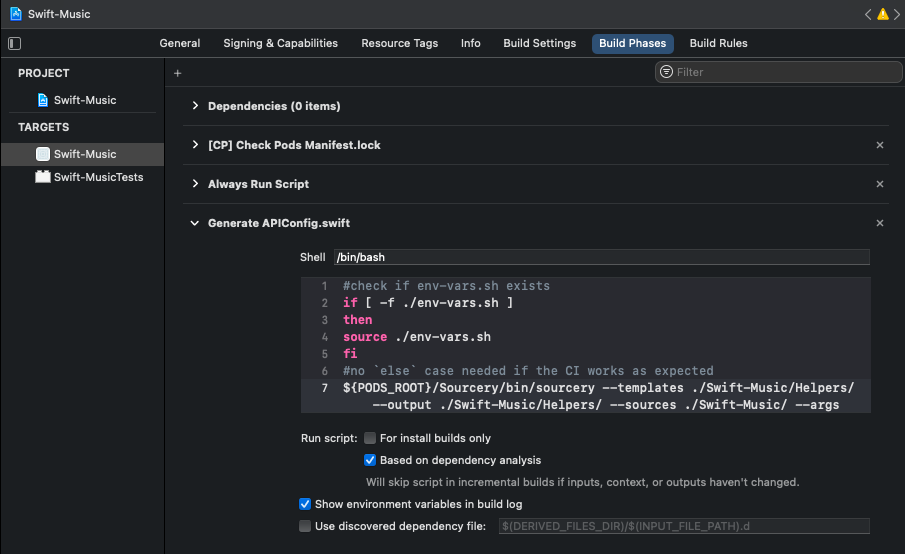
<p>First, lets install Sourcery via CocoaPods. To do this, add <code class="language-plaintext highlighter-rouge">pod 'Sourcery'</code> to your <code class="language-plaintext highlighter-rouge">Podfile</code> before running <code class="language-plaintext highlighter-rouge">pod install</code> to install the dependency. Once installed, we’ll head into Xcode and open the ‘Build Phases’ tab within our example app target. Here we’ll create a new ‘Run Script’ that will run each time our target builds.</p>

<p>(<strong>Note:</strong> This script must be added before the ‘Compile Sources’ script for reasons we’ll come to).</p>

<p><img class="img-blogpost" src="assets/images/sourcery_run_script.png" alt="Sourcery Run Script Magic" /></p>
<p class="figure"><i>Adding a new run script into Build Phases</i></p>

<p>Below is the script used. Each time a new variable is added to our <code class="language-plaintext highlighter-rouge">env-vars.sh</code> file; the script will need to be updated to parse out the variable.</p>
<div class="spacer-code-block" />

<div class="language-plaintext highlighter-rouge"><div class="highlight"><pre class="highlight"><code>if [ -f ./env-vars.sh ]
then
source ./env-vars.sh
fi

${PODS_ROOT}/Sourcery/bin/sourcery --templates ./Swift-Music/Helpers/ --output ./Swift-Music/Helpers/ --sources ./Swift-Music/ --args example_api_key=$EXAMPLE_API_KEY,example_password=$EXAMPLE_PASSWORD
</code></pre></div></div>

<p class="figure"><i>Example run script.</i></p>

<p>In a nutshell, the script will source our <code class="language-plaintext highlighter-rouge">env-vars.sh</code> file, parse out each environment variable before using Sourcery to do its magic and generate our Swift secrets file ✨.</p>

<h4>3. 💻 Swift codegen</h4>
<hr />

<p>You’ll notice our run script makes reference to a <code class="language-plaintext highlighter-rouge">--templates</code> argument. This directory requires a <code class="language-plaintext highlighter-rouge">.stencil</code> template file to be present which Sourcery will use to generate our <code class="language-plaintext highlighter-rouge">.swift</code> file containing our environment variables. We’ll create and name this file <code class="language-plaintext highlighter-rouge">APIConfig.stencil</code> so that <code class="language-plaintext highlighter-rouge">APIConfig.generated.swift</code> is generated.</p>

<div class="spacer-code-block" />

<div class="language-plaintext highlighter-rouge"><div class="highlight"><pre class="highlight"><code>//
//  APIConfig.swift
//  Swift-Music
//
//  Created by James Shaw on 21/08/2021.
//  Copyright © 2021 James Shaw. All rights reserved.
//

import Foundation
import UIKit

public struct APIConfig {
  static let apiKey = "{{ argument.example_api_key }}"
  static let password = "{{ argument.example_password }}"
}
</code></pre></div></div>

<p class="figure"><i>Example APIConfig.stencil file.</i></p>

<p>Now, build the project (⌘+B) once so that our <code class="language-plaintext highlighter-rouge">APIConfig.generated.swift</code> file gets generated like the example below. 🚀</p>

<div class="spacer-code-block" />

<div class="language-plaintext highlighter-rouge"><div class="highlight"><pre class="highlight"><code>// Generated using Sourcery 0.15.0 — https://github.com/krzysztofzablocki/Sourcery
// DO NOT EDIT

//
//  APIConfig.swift
//  Swift-Music
//
//  Created by James Shaw on 21/08/2021.
//  Copyright © 2021 James Shaw. All rights reserved.
//

import Foundation
import UIKit

struct APIConfig {
  static let apiKey = "ABCDEF123456"
  static let password = "PASSWORD"
}
</code></pre></div></div>
<p class="figure"><i>Example APIConfig.generated.swift file.</i></p>

<p>Sourcery will add the generated file into the directory passed as the <code class="language-plaintext highlighter-rouge">--output</code> argument in our build script. Once we drag the file from Finder into our Xcode project, we’ll be able to access the variables from inside our source code. 🎉</p>

<div class="spacer-code-block" />

<div class="language-plaintext highlighter-rouge"><div class="highlight"><pre class="highlight"><code>...
let client = APIClient(key: APIConfig.apiKey)
...
</code></pre></div></div>
<div class="spacer-code-block" />

<p>Now given this file contains all our secrets, we’ll need to make sure it’s added to our <code class="language-plaintext highlighter-rouge">.gitignore</code> too. The file will also need to be added to the ‘Compile Sources’ and this is the reason why our build script needs to run first. 👍🏻</p>

<div class="spacer-code-block" />

<p><strong>PS: Please do make sure your <code class="language-plaintext highlighter-rouge">.generated.swift</code> and <code class="language-plaintext highlighter-rouge">env-vars.sh</code> files get added to your <code class="language-plaintext highlighter-rouge">.gitignore</code> so your secrets don’t accidentally end up in your repo 😅.</strong></p>

<h2>🔚 Wrapping Up...</h2>
<hr />

<p>So there we have it, a simple way to generate environment variables or project secrets in Xcode whilst keeping them out of source control. It's a really important tool and one that becomes even more powerful when building with a CI/CD pipeline. 🔁 Perhaps I'll cover this in a future blog post.</p>

<p>Thanks for reading my post! If you have any questions, feel free to contact me on Twitter <a href="https://twitter.com/jsh8w">@jsh8w</a>.</p>
 ]]></content>
</entry>


  <entry>
  <title type="text">Reflecting on 12 Years of iOS Development</title>
  <link rel="alternate" type="text/html" href="http://shaw-james.com/reflecting-on-12-years-of-ios-development.html" />
  <id>http://shaw-james.com/reflecting-on-12-years-of-ios-development</id>
  <published>2021-06-07T00:00:00Z</published>
  <updated>2021-06-07T00:00:00Z</updated>
  <content type="html"><![CDATA[ <p><img src="assets/images/reflecting_on_12_years_of_ios_development.jpg" alt="iOS" /></p>

<p>As <a href="https://developer.apple.com/wwdc21/"><strong>WWDC 2021</strong></a> 🍎 is in full swing, it's hard to believe that iOS has been around for nearing 14 years. Somewhat as surprising is that I've been an iOS Developer for 12 of those!</p>

<p>I first began my foray into iOS Development back in 2009 with my first app being released in December that year. Since then, a huge amount has changed on the platform with Apple vastly developing their technology and giving developers more and more opportunity to build cool, innovative apps.</p>

<p>In this blog post, I want to discuss the biggest changes I've experienced during the last 12 years.</p>

<h2>👨🏼‍💻 Out with Objective C, in with Swift</h2>
<hr />

<p>Without doubt, the most significant change in iOS Development over the last 12 years was the introduction of Swift at WWDC 2014; and the move away from Objective-C. I, like many other iOS Developers was initially rather suspicious and cautious of this new kid on the block. This wasn't helped by the poor Xcode support, slow compile times and large number of breaking changes that early Swift versions suffered from. (The jump from Swift 2 to 3 was particularly painful!</p>

<p>However, after 7 years of Swift, I ❤️ the language and vastly prefer it to Objective-C! I'm fairly certain that 99% of fellow iOS Developers agree.<p />   

<h2>🎨 Building UI - XIBs, Storyboards, Auto Layout and SwiftUI</h2>
<hr />
<p>As the variety of iOS devices has increased over the years, the complexity of building user interfaces to adapt to the different screen sizes has increased in turn. Initially, with few devices to support; building UIs <strong>programmatically to be pixel perfect</strong> was doable. But very quickly, as the number of devices increased, this approach became unsustainable and Apple introduced Auto Layout.</p>

<p>This changed the game and made it far easier to build dynamic UIs and support different screen sizes. <strong>XIBs and Storyboards</strong> made an appearance to assist in building these UIs. And then most recently, <strong>SwiftUI</strong>; a user interface toolkit that lets us design apps in a declarative way.</p>

<h2>🧠 Memory Management</h2>
<hr />
<p>Before <strong>ARC (Automatic Reference Counting)</strong> was first introduced in October 2011, memory management in Objective-C was an entirely manual process. This was one of the biggest of pains for developers and no doubt led to a huge number of tedious bugs to try and resolve.</p>

<p>If you're not familiar with the days before ARC; essentially whenever an instance of a class is instantiated, a strong reference to said class is created in memory. It was then on the developer to manually deallocate the reference when it was no longer needed. Failure to do so meant that your app contained all sorts of <strong>memory leaks and retain cycle pain</strong>.</p>

<p>Thankfully since iOS 4.2, ARC automatically handles memory management at compile time and alleviates many a headache for developers.</p>

<h2>📱 The World is going Mobile first</h2>
<hr />
<p>Back in 2009, mobile apps were very much <strong>nice-to-haves</strong> for businesses with only the most forward thinking adopting them. Fast forward 12 years and mobile apps are now <strong>must-haves</strong> for businesses with an expectation from customers.</p>

<p>Never has iOS Development been so <strong>relevant</strong> and in demand.</p>

<h2>💰 Approaches to Monetisation</h2>
<hr />
<p>Back in the day at the beginning of the App Store, monetising your app was very straightforward; users made a one-time up-front payment to use your software. Simple.</p>

<p>However, developers quickly became conscious that users wanted to try their apps for free. This led to <strong>'Lite'</strong> versions; an entirely separate app available for free but with a limited functionality. This led to a rather cluttered and bloated App Store!</p>

<p>Apple became savvy to this and introduced in-app purchases; a whole new opportunity for indie developers to monetise their apps. Gone went the Lite versions and in came the free trials and <strong>Freemium</strong> monetisation models. Then at WWDC 2016, Apple introduced the ability for developers to offer auto-renewable subscriptions and with them, an entirely new avenue for developers to charge for their apps.</p>

<p>The changes Apple have implemented have offered developers far more opportunity and variety to how they they can monetise their software. A win for Developers, a win for Users; and a win for Apple.</p>

<h2>💸 There's still Money to be made</h2>
<hr />
<p>When I launched my first app on the App Store back in December 2009, there were <strong>~100k apps</strong> on the iOS App Store. As of today (06/06/2021), there are <strong>~2.2 million</strong>. Hence, the competition is far higher. These two simple stats mean there is no doubt that it is far more difficult to make money from iOS apps in 2021 than it was in 2009.</p>

<p>However, that's not to say that there isn't still the opportunity to make good money on the App Store. If your app solves a problem, is executed and marketed well; then there's no reason it can't be successful. Add in the changes to monetising apps as mentioned above and there's no reason why you can't reap the financial rewards of your efforts.</p>

<h2>🍎 Growth of the Apple Ecosystem</h2>
<hr />
<p>Over the last 12 years, the Apple Ecosystem has grown massively. As of 2021, Apple say there are more than <a href="https://www.theverge.com/2021/1/27/22253162/iphone-users-total-number-billion-apple-tim-cook-q1-2021">1.65 billion active iOS devices</a>! That means the market for iOS Developers to target is one of the biggest in the world. Whilst the competition for apps is higher than ever; the number of potential customers is also higher than ever.</p>

<p>Back in 2009, Developers could also only target iPhone and iPod Touch. Now in 2021, with the release of iPad, Apple Watch and Apple TV; the scope and breadth of apps developers can build is wider than ever.</p>

<h2>🙋🏼‍♂️ The Dev Community</h2>
<hr />
<p>Back in 2009, iOS Developers were relatively few and far between. Only the <strong>iPhone Dev SDK Forum</strong> was a reasonably strong source of community and knowledge.</p>

<p>These days; search for the 'iOS' tag on <a href="https://stackoverflow.com/questions/tagged/ios">Stack Overflow</a> and you will currently be returned 656,724 related questions! Add to that the numerous blogs, podcasts and YouTube channels related to iOS Development and the wealth of knowledge available now is fantastic.</p>

<p>Twitter also provides an extremely vibrant iOS Developer community. Being able to speak and interact with your fellow developers really helps with motivation, drive; and just makes the whole experience a lot more fun.</p>

<h2>🔚 To End...</h2>
<hr />
<p>To say that iOS Development has changed drastically over the last 12 years is a massive understatement. And I for one can't wait to see where iOS Development goes in the next 12 years! 🍿</p>
</p>
 ]]></content>
</entry>


  <entry>
  <title type="text">Helping Someone Experiencing a Panic Attack</title>
  <link rel="alternate" type="text/html" href="http://shaw-james.com/helping-someone-experiencing-a-panic-attack.html" />
  <id>http://shaw-james.com/helping-someone-experiencing-a-panic-attack</id>
  <published>2019-11-21T00:00:00Z</published>
  <updated>2019-11-21T00:00:00Z</updated>
  <content type="html"><![CDATA[ <p><img src="assets/images/helping_someone_experiencing_a_panic_attack.jpg" alt="Panic Attack support" /></p>

<p>(Updated 20/08/2021: This post was originally shared on Medium, <a href="https://medium.com/@jamesshaw95/helping-someone-experiencing-a-panic-attack-5c09f41a1a4">Helping Someone Experiencing a Panic Attack</a>). I've also added it to my blog.</p>

<h2>👨‍👩‍👧‍👦 The dos and don’ts for friends and families with a loved one battling panic attacks.</h2>
<hr />

<p>As a long term sufferer of <strong>Generalised Anxiety Disorder</strong>, I’ve been extremely lucky to have extremely supportive family and friends around me. The manner in which your nearest and dearest relate to your condition really makes a massive difference, and I can’t imagine having to battle an anxiety disorder without the support of others.</p>

<p>One of the most common symptoms of anxiety disorders is <strong>panic attacks</strong>. I have experienced many panic attacks over the years and they really aren’t pleasant in the slightest. Panic attacks occur when a person suffers from an acute burst of anxiety which then causes extremely intense mental and physical symptoms. Whilst <strong>panic attacks can be of different severities</strong>, the most common symptoms include:</p>

<ul>
  <li>Nausea and sickness.</li>
  <li>Breathing difficulties.</li>
  <li>Hyperventilating.</li>
  <li>Irrational thinking and not being able to coherently and logically function.</li>
  <li>Sweaty palms, dry mouth and tight chest.</li>
  <li>Heart palpitations.</li>
  <li>The seemingly uncontrollable feeling of being trapped.</li>
</ul>

<p>From personal experience, given the intense nature of these symptoms, I’ve always been really concerned about <strong>experiencing a panic attack in public</strong> and with other people. I strongly believe that this is the case with many other fellow panic attack sufferers. It’s therefore really reassuring and comforting to know, that the people you spend most time with are going to be understanding, empathetic and show no judgement if and when you experience a panic attack.</p>

<p>The list before is a non-exhaustive list of things to do and not do when someone suffers from a panic attack.</p>

<h2>✅ Do</h2>
<hr />

<p><strong>✅ Do remind the person that their symptoms are only temporary.</strong> Panic attacks are short bursts of intense physical symptoms but will never last forever. In fact, from personal experience, I’ve never had a panic attack last longer than 45 minutes. For someone in the middle of a panic attack, it’s extremely comforting to know that their symptoms will soon subside to a more manageable level.</p>

<p><strong>✅ Do offer to stay with the person or let them be on their own if they wish.</strong> All panic attack sufferers are different; some prefer to be in the company of others to help comfort them, whilst others prefer just to be on their own to calm down. Gently suggest both options and tell the person you are perfectly happy to accommodate either.</p>

<p><strong>✅ Do encourage the person to focus on their breathing.</strong> When someone is experiencing a panic attack, it is likely their breathing is fast and short. This unintentionally results in an increased heart rate and in turn activates the person’s “fight or flight” mode. This heightened sense of awareness results in even worse physical symptoms. The key to counteract this is to intentionally make slow, deep breaths through the diaphragm and really focus on the physical sensations of the stomach expanding and contracting. Encourage the person to breathe in for 6 seconds, hold for 4, and then breathe out for 6.</p>

<p><strong>✅ Do offer to get the person a glass of water.</strong> Similar to slow, deep breathing, drinking a glass of water gives the person an opportunity to really focus on the sensations of taste and drinking rather than their physical symptoms.</p>

<p><strong>✅ Do remind the person that they can do whatever they feel they need do.</strong> The last thing the person wants is to feel obliged to stay in the situation they are currently in. Offer them an “escape route” to remove themselves from the current situation. For example, if you’re in a crowded restaurant, offer to get some fresh air outside or even accompany them home. But most important of all, don’t pressure them into doing something they don’t want to do.</p>

<p><strong>✅ Do message or call the person to check if they’re okay.</strong> Later the same day or perhaps the next, get in touch with the person to see how they’re doing. From personal experience, it could be that the person is feeling embarrassed and ashamed of what happened. They may therefore be hesitant of getting in touch so messaging them first and sending them good wishes is a big thing to alleviate their worries. Suggest hanging out with them too as soon as they’re feeling up to it.</p>

<p><strong>✅ Do remind the person how much you enjoy hanging out with them.</strong> Many anxiety sufferers are worried about having panic attacks in public as they’re not sure how people will react. Gently remind them that having an anxiety disorder doesn’t define who they are, and that you love hanging out with them no matter if their anxiety is visible or not.</p>

<p><strong>✅ Do show empathy and understanding.</strong> Showing empathy and understanding is crucial in letting the person know that you’re there to support them and help them through their anxiety battles.</p>

<h2>❌ Don't</h2>
<hr />

<p><strong>❌ Don’t tell the person that they’ve got nothing to be anxious about.</strong> Whilst it may seem reassuring, telling the person they have nothing to worry about is not helpful. The rational part of the person’s brain is likely well aware that they have nothing to be anxious about. The person is likely very frustrated that they’re feeling anxious when deep down they know that they have no reason to be. You confirming this is only likely to add to the frustration.</p>

<p><strong>❌ Don’t be frustrated or irritated with the person.</strong> Whilst this my seem extremely obvious, the last thing the person needs is to see you being frustrated and not understanding. They didn’t wake up in the morning and decide to have a panic attack for a laugh; and they’re certainly not in control of it happening. Personally, my biggest concern about having a panic attack in public was being an inconvenience to others. Showing frustration just confirms to the person that you think they’re an inconvenience. Furthermore to be quite frank, someone showing frustration to someone having a panic attack is not someone I’d like to spend time with.</p>

<p><strong>❌ Don’t ask the person why they are anxious.</strong> The chances are that the person themselves doesn’t know. Asking the question during the panic attack could lead to the person becoming more anxious as they can’t work out why.</p>

<p><strong>❌ Don’t remain silent pretending everything is okay.</strong> This is only going to make the person feel like you don’t understand how they’re feeling and you’re not accepting how they feel.</p>

<h2>🔚 Conclusion</h2>
<hr />

<p>So there it is; a simple list of dos and don’ts for those in the company of someone experiencing a panic attack. Whilst this list is by no means exhaustive, the things listed really help me when I’m experiencing a panic attack.</p>

<p>Lastly, it is hugely important that the person suffering from a panic attack is within the company of people that they truly feel comfortable with. Whilst it may not seem like much, the simple act of gently saying that the symptoms won’t last forever can be really comforting.</p>
 ]]></content>
</entry>


  <entry>
  <title type="text">James' 10 Tips to Beat Anxiety</title>
  <link rel="alternate" type="text/html" href="http://shaw-james.com/james-10-tips-to-beat-anxiety.html" />
  <id>http://shaw-james.com/james-10-tips-to-beat-anxiety</id>
  <published>2018-12-20T00:00:00Z</published>
  <updated>2018-12-20T00:00:00Z</updated>
  <content type="html"><![CDATA[ <p><img src="assets/images/james-10-tips-to-beat-anxiety.jpeg" alt="Anxiety Disorder" /></p>

<p>(Updated 21/08/2021: I originally shared this post on Medium in 2018, <a href="https://medium.com/@jamesshaw95/james-10-tips-to-beat-anxiety-e8211dadfde4">James' 10 Tips to Beat Anxiety</a>). I've also added it to my blog.</p>

<h2>👋🏻 Introduction</h2>
<hr />

<p>As some may have seen, my last post detailed my long standing battle with anxiety. In the last two years especially, I’ve learnt a huge amount about the tools and techniques needed to overcome it. By making changes to my lifestyle, behaviour, diet; forcing myself to be exposed to situations that make me anxious, and regularly practicing meditation and mindfulness, I am beginning to feel like my old self. And it feels fantastic!</p>

<p>In this post, I’ll be writing about the changes that I’ve made, and the results they’ve had. Obviously, this is by no means an exhaustive list of things that help with anxiety. But these are the things that have helped me most; and I really hope that they help others who are currently suffering with anxiety or other mental health issues.</p>

<h2>1. 🤝 Acceptance</h2>
<hr />

<p>The first, and in my opinion, most important thing to beating anxiety, is just accepting that you suffer from it. That might seem like such a small thing, but it can make the world of difference.</p>

<p>For a long, long time, I felt really embarrassed and ashamed that I struggled with anxiety. That caused me to be really guarded about it and created huge barriers which prevented me from opening up about it. But over time, I have come to accept that it’s part of who I am and I shouldn’t feel ashamed about it. It’s not mine, or anybodies fault that I struggle with anxiety. Based on my genetics and experiences that I’ve had in my life, it’s just one of the many cards that I have been dealt. I accept it’s just one of the many personality traits I have, and that’s perfectly okay.</p>

<p>At its rawest, anxiety is just an emotion. And like any emotion, some people experience more of it than others. Again, that’s perfectly okay. You wouldn’t beat yourself up for experiencing a lot of happiness or excitement, so why would you beat yourself up for experiencing a lot of anxiety?</p>

<p>As I’ve been able to accept my anxiety, the embarrassment and shame that I once felt has gradually disappeared. In turn, this has enabled me to be far more open about it and talk to more and more people. I have also been able to show far more compassion and kindness towards myself, and this has helped me enormously.</p>

<p>Accepting anxiety is hard, it took me the best part of ten years! But without doubt, it has been one of the biggest things in helping me overcome it. So I really encourage all anxiety sufferers to show themselves enough compassion to just be able to accept that they struggle with it.</p>

<h2>2. 💪🏻 Exposure</h2>
<hr />

<p>I won’t beat around the bush here. The hard truth is that exposing yourself to situations that make you anxious is one of the most important techniques to beating anxiety. Clearly, this can make you feel really uncomfortable so exposure is difficult. But it’s all about short term pain for long term gain.</p>

<p>It’s very easy to shy away from anxiety provoking situations, as it sometimes feels like doing this will protect ourselves from pain. However, unfortunately in doing this, we are actually making the anxiety worse as it just reinforces our belief that we should be anxious about the situation in question.</p>

<p>With exposure being so difficult, it’s important to approach it in the right way. My personal opinion is that little, and often is more beneficial than just throwing yourself in the deep end and hoping for the best. Whilst I do believe that there are times in life where it’s good to put yourself in a sink or swim situation, dealing with anxiety is not one of them. The risks of sinking are simply far too great, and you could easily end up back at square one if something doesn’t go to plan.</p>

<p>Instead, what’s worked for me is regularly putting myself in anxiety provoking situations and gradually increasing the ‘difficulty’ until the situation is no longer a problem. For example, at university, social situations became a major problem. So over the last two years, I’ve forced myself into more and more social situations until going for drinks, meals etc is now not a problem. I started by going for drinks with some of my closest friends every week. Once I was comfortable with doing that, we started going for meals. Once that was okay, I started going out with people I didn’t know quite so well. And so on, and so forth, until I wasn't batting an eyelid at simple, everyday situations that were previously causing me such problems.
Exposure can be really hard and it takes a great amount of courage to keep forcing yourself into situations that make you uncomfortable. But trust me, it’s 100% worth it and you will definitely reap the rewards of your efforts.</p>

<h2> 3. 💊 Medication</h2>
<hr />

<p>First of all, there is absolutely no shame in taking medication for mental health related illnesses. If you have a physical headache, most people will take some paracetamol to help. So if you have a mental illness, why would it not be okay to take some medication for this too?</p>

<p>Over the years, I have been prescribed two medications for my anxiety. The first was Propranolol, a beta-blocker used to reduce the physical symptoms that anxiety causes. It helped me to get through University and was exactly what I needed at the time. The second is Setraline, an anti-depressant used to treat both depression and anxiety. I’ve only been on Setraline for about six weeks, but I’m already starting to see the positive impact that it’s having.</p>

<p>Whilst I personally don’t see medication as a long term fix, it can be hugely helpful in giving yourself a bit of breathing space from the anxiety and allow you to address it. This can be incredibly valuable. If you are considering medication, I gently recommend you first speak with a Doctor to discuss what medication would be best for you.</p>

<h2>4. 🧘🏼 Mindfulness and Meditation</h2>
<hr />

<p>I first became aware of mindfulness and meditation during Cognitive Behaviour Therapy whilst at University. Initially I was pretty dubious of the benefits they could offer, but over time I’ve realised how powerful they are and the positive impact they can have. Essentially, both mindfulness and meditation aim to bring more awareness to ourselves and the world around us, and help us live more “in the moment” (I’m cringing at that phrase!).</p>

<p>Anxiety is essentially a habit. The mind becomes stuck in its ways and develops negative thought patterns that become automatic in certain situations. So no matter what we do, we find ourselves feeling anxious because it’s a reaction that we’re not in control of. Mindfulness and meditation work by breaking these patterns and instead, create new neural pathways in the brain for us to follow. There is scientific evidence to support this.</p>

<p>Ever got so lost in thought in your own head, that you forgot what you were doing? Mindfulness is all about bringing yourself back to the present moment when your thoughts start to spiral. I currently have three main activities where I practise mindfulness; on my walk to/from work, whilst I’m having a shower, and when I’m brushing my teeth. I’m lucky that my commute to work is a 20 minute walk by the River Ouse and through a park. I put my phone on ‘Do not disturb’ and really focus on the sights, smells, sounds and physical sensations of walking. I’ve realised how much has been passing me by, and now appreciate the beauty of the world around me so much more. Naturally, my mind sometimes gets distracted. But I’m not self-critical, I just gently bring myself back to the physical sensations of my breath and focus on the world around me. It sounds so simple, but it’s really powerful.</p>

<p>Similar to mindfulness, meditation is now part of my daily routine. Even if I only manage to spend ten minutes a day meditating, I notice it makes a huge difference to my anxiety levels and mood in general. I currently use Headspace as my meditation guide and have apparently spent 38 hours meditating with it this year. Now I’m not going to lie, to start with, I often found that I was thinking “What a load of rubbish this meditation lark is!”! But the more I’ve practised it, the more I’ve seen the huge positive impact that it can have. I’ll write a future blog post about my tips to practising meditation.
Like many people, I am incredibly busy and often find that free time is of the essence. Naturally, I want to make the most of it and do fun things, so I sometimes find myself thinking “How can I afford time to meditate?”. However, after seeing the benefits that meditation offers, I quickly rephrase that question to be “How can I afford not to meditate?”.</p>

<h2>5. 🗣 Talking About it</h2>
<hr />

<p>Similar to exposure, talking about anxiety and mental health can be really hard, particularly if you feel embarrassed or ashamed of how you feel. But also like exposure, it’s one of the most important tools to beating anxiety.</p>

<p>Unfortunately, there is currently a stigma associated with mental illness that contributes to making it really hard to talk about. This can sometimes mean that we feel like we’re the only person in the world that suffers with it. But in fact, it’s incredibly common. Since I’ve started being more open about my anxiety, I’ve been amazed by the number of people I’ve opened up to, who also struggle with anxiety. I can’t tell you how comforting it is to talk openly with someone who truly understands what suffering from anxiety is like. It feels really good when somebody says something that you can truly resonate with, and it makes you realise that everybody is fighting their own inner battle.</p>

<p>I was very guarded about my anxiety, and whilst I don’t regret that because I was doing what I thought was best at the time, I can now see that being more open about it would have been more beneficial. As I’ve gradually opened up to more and more people, my anxiety has got better and better. That definitely isn’t a coincidence. I was always very concerned about how people would react. Naturally, it made sense to avoid doing it, but unfortunately this just made matters worse. Since I’ve started talking about it, 99% of people have been incredibly supportive and understanding. This has helped enormously. Naturally, you do get the odd person who just doesn’t get it, but that’s not your fault in the slightest. It may be that the person doesn’t know how to deal with it themselves. So think of yourself as doing them a favour as they’ll know how to deal with it better next time.</p>

<p>Opening up to people is a hard. Similar to exposure, it requires a great deal of courage but it’s 100% worth it. I’d really encourage anyone who is bottling up their problems to share them; it can really make a huge difference.</p>

<h2>6. ⏱ Take time out for Yourself</h2>
<hr />

<p>Struggling with anxiety can be really tough. At times, it can be tiring and distressing so it’s important to recognise when things are starting to get a bit too much and that you need to take some time out. In these moments, you want to be doing activities that give you the most enjoyment, and most importantly cause you no anxiety. Whether that be watching your favourite TV show, playing your favourite sport or reading a book, it needs to be something that gives you a bit of space and time to just relax.</p>

<p>For me, if I notice that I’m feeling particularly anxious, I’ll take an evening off and just spend some time chilling in my flat. I’ll turn my phone off, watch a TV series and cook my favourite meal (or grab a takeaway if I can’t be bothered!). I’ll practise some meditation and just reflect on how far I’ve come on my anxiety journey. I’m compassionate to myself and just feel how I feel.</p>

<p>At the end of the day, you should prioritise your health very highly. And if that means taking some time out to chill, then it’s 100% worth it.</p>

<h2>7. 🏃🏼 Exercise</h2>
<hr />

<p>Exercise is a massively powerful tool in helping to reduce anxiety. Not only does it improve our physical health and keep us in good shape, but it also has a really positive impact on our mental health, mood and stress/energy levels. Participating in sports also offers the chance to play in teams and make some really good friends.</p>

<p>I’m lucky that I’ve always been very sporty so have always found exercise easy to come by. At the moment, I play tennis, squash and football most weeks with a bit of golf thrown in every now and again. After a tough day at work, there’s nothing I love more than running round a football pitch for two hours, or hitting a tennis ball as hard as I can! After about an hour of intense tennis, I really feel the endorphins kicking in and it feels amazing. Any problems of the day just seem to drift away and you can’t help but feel good (even if you have lost the match!). I’m also usually shattered, so I’m pretty much guaranteed to get a good nights sleep that night!</p>

<p>In my opinion, there are literally no downsides to exercising and playing sports. I’d really encourage anyone thinking of starting to just go for it, it will have a big, positive impact on your mental health.</p>

<h2>8. 🍓 Diet and Alcohol</h2>
<hr />

<p>It’s important to recognise that the food and drink you put in your body have an impact on anxiety. Whilst I’m the first to admit that I could eat far healthier, I do make a conscious effort to try and eat a (relatively!) balanced diet. Also for some reason, if I feel hungry, I notice that my anxiety levels increase, so I try to make sure that I eat plenty in order to keep my energy levels high.</p>

<p>One of the biggest changes I’ve made is massively reducing my caffeine intake to the point at which I’m basically caffeine-free (ish!). Whilst I may have the odd diet coke in a restaurant, the rest of the time I don’t drink any caffeine. Whilst that does mean waking up in a morning can be (traumatically! 😉) difficult, it’s really improved my anxiety and I feel far less jittery without it. If there’s one diet change I would recommend, it would be this one.</p>

<p>Whilst I’ve never been a big drinker, there’s no doubt that excessive alcohol does have a large, negative impact on anxiety. Whilst it’s always good fun to have a few drinks and enjoy yourself, I’ve always found that my anxiety levels are always a lot higher the next day. Sometimes, it can even take a few days to settle back down again. And in my opinion, it’s just not worth it. Whilst I still like going out for drinks with friends, I usually limit myself to 3 drinks so I always feel just as good the next day, as I do when I’m out with friends.</p>

<h2>9. 💤 Sleep</h2>
<hr />

<p>Getting enough sleep is really important for reducing anxiety. Having to face anxiety on its own is difficult enough, let alone if you’re constantly tired. So if that means sleeping in until 11am every now and again, then that’s perfectly okay.</p>

<p>As I’ve mentioned above, since starting work, my free-time is of the essence. So it’s often tempting to stay up that little bit longer to make the most of the time after work. But that extra 30 minutes stuck in a YouTube loop always comes back to bite the following morning, when I’m trying to drag myself out of bed at 7am!</p>

<h2>10. 📅 Routine</h2>
<hr />

<p>One of the most simple, yet effective techniques for dealing with anxiety is to establish a regular daily routine. Whilst it might be considered a bit boring, having a routine brings familiarity when the mind is agitated, and also helps to alleviate any surprises that might trigger higher levels of anxiety. By no means does this mean doing the same thing every day, but a general structure can be really helpful. It can also be really beneficial for productivity and prioritising things that are most important to you.</p>

<p>For me, like most people, the working week offers a lot of routine and has been one of the biggest factors as to why I’ve improved so much over the last two years. The familiarity can be really comforting, particularly when my anxiety levels are high.</p>

<p>Whilst the weekend offers less structure, I still try to plan out what I’m going to do. I then put it in my phone calendar and try to stick to it. I find that I’m so much more productive and this stops me from just sitting in front of the TV all day! Over time as my anxiety has improved, I’ve also found that doing more and more spontaneous things is less of an issue, and I really hope this trend continues!</p>

<h2>🔚 Wrapping up…</h2>
<hr />

<p>Suffering from anxiety can be really tough, but beating it is by no means insurmountable. By adopting some of the techniques I’ve mentioned, and making small lifestyle changes, you can start to make huge inroads into overcoming it. Naturally, there may be a few setbacks where things don’t go to plan. But then again, nothing in life worth having comes easy.</p>

<p>I really encourage everyone reading this to care for their mental health as they would their physical health, it’s just as important. But if you are ever feeling down, then that’s perfectly okay. You’re a human being, and it’s okay to not be okay.</p>

<p>As I’m writing this, the festive season is rapidly approaching. Whilst Christmas can be one of the happiest times of the year, it can also provoke a lot of tension for anxiety sufferers. Going to family occasions, work Christmas parties and everything else can sometimes get a little bit too much. If this is the case, then that’s perfectly okay. Just take some time for yourself and show yourself the same compassion as you would to a friend, if they were suffering with the same problem.</p>

<p>Lastly, I wish everyone a very Merry Christmas, and a happy, anxiety-free New Year!</p>
 ]]></content>
</entry>


  <entry>
  <title type="text">It's Okay to not be Okay</title>
  <link rel="alternate" type="text/html" href="http://shaw-james.com/its-okay-to-not-be-okay.html" />
  <id>http://shaw-james.com/its-okay-to-not-be-okay</id>
  <published>2018-12-02T00:00:00Z</published>
  <updated>2018-12-02T00:00:00Z</updated>
  <content type="html"><![CDATA[ <p><img src="assets/images/its_okay_to_not_be_okay.png" alt="Anxiety Disorder" /></p>

<p>(Updated 21/08/2021: I originally shared this post on Medium in 2018, <a href="https://medium.com/@jamesshaw95/its-okay-to-not-be-okay-619a22444149">It's Okay to not be Okay</a>). I've also added it to my blog.</p>

<h2>👋🏻 Introduction</h2>
<hr />

<p>Hello 👋🏻, I’m James! I’m 23, live in York and work as a Software Engineer. I’ve struggled with Generalised Anxiety Disorder for as long as I can remember. It’s been a big part of my life but I’ve always been very guarded about it; partly due to embarrassment, partly due to not knowing how to deal with it and partly due to not knowing how people would react to it. This has made it really hard to talk but over time I’ve come to accept that it’s part of who I am, and I shouldn’t be ashamed about it. 😊</p>

<p>It’s been a long, tough journey, but after 12 years since it first became a problem, I now feel that I’ve very nearly won my biggest battle! 💪🏻 As the years have gone by, I’ve gradually become more and more open about it and have started talking to more and more people. It feels like the right time get everything out there so I’ve decided to create this blog to share my story and battle with anxiety. Naturally, I’m a bit jittery about it; but I think it’s the right thing to do and will be a big step for me moving forwards.</p>

<p>I also really hope that it helps others that are suffering with anxiety and other mental illness. Mental health currently has a stigma attached to it, and I hope this is my small contribution in breaking the stigma. I have no doubt that some of the things I’m going to write about will resonate with many people who are currently suffering in silence. I really hope the blog encourages them to speak out and get the support they need. 👍🏻</p>

<p>In this first post, I think it makes sense to go through the first 23 years of my life, talk about everything I’ve experienced with anxiety and get it out there! Being a relatively introverted, British guy 🇬🇧; I don’t find talking about myself particularly easy. I feel pretty uncomfortable about some of stuff I’m going to write about in this post and am cringing at the the number of times I’m going to have to write ‘I’! But I think it’s the right thing to do. It’s a bit of an essay, so get your popcorn ready, here we go!</p>

<h2>🚌 Early Years and Primary School</h2>
<hr />

<p>I was really lucky to have a fantastic start in life! 🙌🏻 I was born in Scarborough (affectionally known as Scarbados! ☀️) and spent the first 18 years of my life living there. I am extremely blessed to have been brought up by the most loving, caring family I could possibly wish for and they have given me everything. I am incredibly grateful for everything they have done for me.</p>

<p>Looking back, I’ve got nothing but extremely happy memories of my early childhood and time at primary school. I had an amazing group of friends, played as many different sports as I possibly could, took part in school productions, and was just a really, really happy kid. I absolutely loved life, threw myself into everything life had to offer and hadn’t got a care in the world. Exactly how it should be at that age.</p>

<p>During these early years, I developed a huge love of tennis 🎾 from my Grandparents and played it as much as I possibly could. As the end of primary school neared, I realised I wanted to continue this passion as much as possible, so decided to go to a different secondary school to most of my primary school friends. It meant I could play tennis before and after school and also play for the school team up and down the country.</p>

<p>I left primary school with really happy memories and was excited to start secondary school.</p>

<h2>📚 Secondary School</h2>
<hr />

<p>I started secondary school with much excitement but was immediately struck by how vastly different it was to my primary school. My primary school had been extremely friendly and welcoming, but somehow my new school felt entirely the opposite. I made some good friends but there were also a fair few people I didn’t see eye to eye with. 😬</p>

<p>During my first year of school, I started to notice I was becoming increasingly nervous about situations I previously hadn’t batted an eyelid at. Before playing sports matches, giving presentations, or just answering questions in class; I noticed my stomach being in a knot, my mouth drying up and just feeling a bit shaky. 😟 I couldn’t understand why, because all of these things had previously caused me no problems whatsoever. I presumed it was just a phase that everybody went through and it would pass sooner rather than later. Unfortunately, this was not the case and the problem escalated quite quickly. I found that the more I told myself I had nothing to be anxious about, the worse it got; and I just couldn’t understand this for the life of me. The thing I found most strange was that I was only anxious before the event, during the event I was usually absolutely fine.</p>

<p>Looking back, I remember it getting to the point where I was so anxious before each day of school, that I couldn’t eat breakfast. I was embarrassed and ashamed of how I was feeling and couldn’t understand how I had gone from being so confident and happy at primary school; to being so crippled by anxiety at secondary school. This embarrassment naturally meant I was very guarded about it, so only my immediate family knew about what I was going through. I really didn’t want anyone at school to know what I was going through so I learnt how to hide my anxiety and appear confident, relaxed and happy on the outside even if I was feeling really anxious inside. This is a trait that became a habit and whilst it proved useful in certain situations, its long term effects have been counter-productive. It made it easy for me to bottle things up because nobody knew when I was actually feeling anxious and therefore were unable to help me. I am often told that I’m a ‘smiley’ person 😁. So over the years, whenever I’ve told someone that I have an anxiety disorder; they are usually quite surprised and the usual response is “Wow, I would never have known!”. I’m obviously a great actor so if any Hollywood producers are reading this, you know where I am! 😜</p>

<p>As secondary school went on, certain situations were starting to cause me such anxiety that I began to have episodes where I would experience very intense physical symptoms but for a relatively short period of time. My stomach would feel horrifically tense, my chest and neck would tighten, and my breathing would become extremely shallow and fast. I’d feel very sick and often throw up even though I was desperately trying not to. 🤢 In particularly bad episodes, I would start hyperventilating, feel very faint and be unable to move my hands because they felt so numb. It was awful, but I had absolutely no idea how to stop it happening. 😣 It may sound silly, but at the time I didn’t recognise that it was my anxiety causing these intense physical symptoms. In my mind, health issues were things such as breaking your arm, having a migraine or having flu. I had no idea about mental illness and didn’t understand that thoughts in your head could have such a profound impact on your physical health. It’s only in recent years that I’ve realised all these episodes were panic attacks. 😔</p>

<p>The panic attacks began to happen more and more often and they became a major problem. When I was experiencing such physical symptoms, it was impossible for me to present myself how I wished so I became anxious about having panic attacks in public. It was a tough time but my parents were hugely supportive with what I was going through and recognised I needed some help. I started to see a Psychologist 👨🏼‍⚕️ and also tried Hypnotherapy and Acupuncture. I don’t really remember too much about this but I think it helped a bit and I was a slightly more relaxed at school. However, at this young age I didn’t know anything about mental health and didn’t really appreciate the severity of what I was going through.</p>

<p>My anxiety began to improve slightly but then when I was 14, my Dad was diagnosed with cancer. Understandably this had a profound impact on my anxiety and I was essentially in a constant state of worry for 2 and a half years. It was a really tough time but my family and I were all hugely relieved and grateful when my Dad was given the all clear. I am immensely proud of my Dad for having the fight and determination to beat such a dreadful illness. The treatment cycles were incredibly tough and the resilience he showed has been truly inspirational. I am also hugely proud of my Mum; for having the strength to support my Dad, carry on with her job, and also continue to support me with my anxiety. I will never forget the strength my parents showed in these years, it was truly incredible.</p>

<p>Whilst I was hugely relieved that my Dad was okay, the years of constant worry had taken its toll on me and my anxiety had become a very stubborn habit. No matter what I tried to do, my mind seemed to constantly try and find things to worry about. I was utterly helpless and couldn’t do anything to stop it. 😩</p>

<p>I am lucky that I have always been a hugely driven and motivated person. But during secondary school, these qualities took an unhealthy turn when I started to develop perfectionist tendencies and became extremely self-critical in everything that I did. Nothing I did was ever good enough; and when I did do well at something, it was always down to luck rather than judgement. I found it very difficult to appreciate my successes and a classic example of this was when I got my GCSE results. I achieved 9 A*/As and 1 B but take a wild guess at which grade I thought about most and beat myself up about…! 🙄 This self-criticism continued to be a problem and whilst I didn’t realise at the time, it was a driving factor behind the anxiety I was experiencing.</p>

<p>My time at secondary school has had a profound impact on my mental health and I can link many of my more recent struggles back to these years. By the end of Year 11, I had become a shy, withdrawn teenager with a huge lack of self-confidence; the complete opposite to what I was at primary school and this upset me greatly. 😢 It was a tough time but it made me develop a resilience to always hang in there when the going got tough. I was ready for a fresh start so was excited to start sixth form and be back with all my primary school friends.</p>

<h2>📘 Sixth Form</h2>
<hr />

<p>Once I’d got past the initial anxiety of starting sixth form, I settled in really well and it was fantastic to be back with my primary school friends. In turn, my anxiety levels dropped, my self-confidence increased and I found myself quite enjoying life again. However, the background noise of anxiety was still there because it had become such a habit during secondary school.
My subjects at sixth form were Maths, Physics, Computing and Economics; and it was great to finally do work that I actually found interesting. However, as the workload ramped up, so did my anxiety and it started to become a major problem again. My subjects were pretty exam intensive so during exam seasons, where I would spend pretty much all my time revising, my anxiety really flared up. I started to experience panic attacks again and it was difficult to focus on work.</p>

<p>At the same time, there was also the thought of University in my mind. It was a very daunting prospect but I knew it was something I had to do if I wanted to achieve my career goals. I was still extremely motivated and driven, and I knew I had to force myself to go. I began the process of applying to Universities and went for interview days at all of them. All my choices were competitive Universities and I remember feeling a huge amount of self-induced pressure before each interview day. I had panic attacks before going to York, Durham, Sheffield and Lancaster. Clearly, this isn’t ideal when trying to present yourself in your best light! The Sheffield one was particularly bad and I remember it vividly; it happened on a crowded train so I couldn’t ‘escape’ to sort myself out. I started hyper-ventilating but somehow managed not to throw up. It was horrible but I forced myself to push through and did the interview no problem. I was relieved when I managed to get offers from all my choices.</p>

<p>From there on, sixth form went extremely quickly and it’s all a bit of a blur. I worked really hard and managed to get the grades I needed to get into York to study Computer Science. It was a huge relief and for one of the first times, I was actually proud of what I had achieved. Whilst I was extremely anxious about going to University, I saw it as another fresh start and was optimistic that my anxiety would improve once I got there. 🙏🏻</p>

<h2>🎓 University</h2>
<hr />

<p>As expected, I was extremely nervous about going to University. Moving away from home to a new city, by yourself, for the first time is a big deal for anyone, let alone someone with an anxiety disorder. However, I had heard many times that University would be “the best years of your life” and I was determined to give it shot. After all, maybe it would be the answer to my anxiety problems. I grit my teeth and forced myself to go.</p>

<p>I was pleasantly surprised when I actually coped with the first few weeks pretty well, and this was a big confidence boost. It felt like I’d left all the baggage of my anxiety in Scarborough, and I was ready to restart my life! It was exciting to meet so many likeminded, new people, all with different stories to tell. I made some really great friends, was enjoying my course, and was also chosen to play in the tennis 1st team against other unis.</p>

<p>It was all going so well, but then, like sixth form, when the workload started to increase, my anxiety decided to make another delightful appearance. I’m still not 100% sure what triggered it but it escalated very quickly and was back with a vengeance. Like secondary school, I started to become very anxious before tennis matches, public speaking and for the first time, social situations. I couldn’t understand the latter for the life of me. I have always enjoyed being with people and love nothing more than dishing out friendly (often poor!) banter to my mates and getting a fair bit back myself. I had made some fantastic friends at uni and really enjoyed their company, yet for some crazy reason I was getting really anxious about going out to restaurants, pubs, bars, or any other social situation. To start with, the anxiety only made itself known before the event. But over time, it got worse and worse until I was experiencing severe anxiety before and during the situations. I started to have panic attacks during these events and once again, I felt very embarrassed and ashamed of it. Naturally, I wanted to try and hide it as much as possible, so told very few people at uni. The only people I really opened up to were my housemates and they were incredibly supportive about it.</p>

<p>The panic attacks became more and more regular until I was in a constant state of severe anxiety. Pretty much everything I did in life became a problem and I was utterly miserable. Some particularly vivid memories of panic attacks were at a tennis match in Sheffield (fortunately I made it to the loo!), at the check-out in Morrisons, walking to the pub quiz with my housemates, getting my hair cut at the barbers and before a housemates birthday at a pottery painting place. Just leaving the house and thinking who I might bump into was causing me anxiety. I was at absolute rock bottom, and I wouldn’t wish what I went through on anyone. It might sound a bit dramatic, but I was just surviving, not living.</p>

<p>To add to the fun, my self-criticism decided to join the party. I became very harsh on myself about the way I was feeling and couldn’t believe I’d let myself get to that point. Words along the lines of “get a grip” were regularly going through my mind and this just amplified the anxiety. This was a bit ironic, because if it had been one of my friends that had been experiencing the anxiety, I would have shown a great deal of compassion, understanding and empathy. But because it was happening to me, I was unable to show the same compassion.</p>

<p>I was having so many panic attacks, that I started to become anxious about having them in public. So I was anxious, about being anxious, because then I might have a panic attack (really logical thinking..!). And that brings us nicely onto the lovely subject of exams. Once again, I had chosen a subject that was extremely exam intensive and exam seasons were brutal. I was not only anxious the exam content, but also about having a panic attack in the exam room and ruining my chances of getting a good mark. For the final year of uni, I actually approached the university’s exam office and asked if there was anything they could do to help me. They recognised the severity of what I was going through and offered me 25% extra time in all exams in case I had a panic attack. However, I declined their offer because I felt like a fraud who didn’t deserve the extra help, and would have an unfair advantage over my course-mates. During my final exam season, I had a panic attack at the beginning of one of my exams. My initial reaction was “Ohhhhh boyyy, here we go!” (Maybe slightly ruder language!), but fortunately I managed to calm myself down in about 15 minutes and was able to continue with the exam. Ironically, I managed to get one of my best exam marks so maybe if I’d had panic attacks in a few more exams, I might have got a 1st! 😉</p>

<p>As university went on, I began to become a bit more open about my anxiety. At the end of my first year, I recognised I needed some help so decided to start Cognitive Behaviour Therapy (CBT). It was a big relief to get everything out and talk to someone who had clearly seen it all before. My therapist was really understanding and we got on really well. I’m not sure that more laughs have ever been had in a counselling room! I went to CBT for ~18 months and whilst I didn’t improve a huge amount whilst I was going, it prevented me from getting any worse and helped me get through uni. It was also the first time that I became aware of strategies and techniques to manage the anxiety, and these have been invaluable in recent years.
Before my final exam season, I again recognised that I needed some help so went to my GP to see if there was any medication I could take to get me through the exams. I was prescribed Propranolol, a beta-blocker mainly used to treat high-blood pressure, but also anxiety. The tablet is designed to slow your heart rate, and hence reduce the physical symptoms that the anxiety causes. Whilst the physical symptoms didn’t disappear, they did reduce to a more manageable level and that helped me get through the exam season.</p>

<p>My three years at uni were the toughest years of my life but there was absolutely no way I was going to quit. I honestly didn’t once consider throwing in the towel. I was all too aware of the doors a Computer Science degree from York could open, and there was absolutely no chance I was letting that opportunity pass me by. Somehow, I managed to graduate with a 2.1 and I am immensely proud of having enough resilience and determination to achieve this. At times I was really hanging in there, but I’m so glad that I was able to grit my teeth, tough it out and come through the other side.
By the end of uni, I was in a pretty bad way so took the summer off to clear my head and try and sort myself out. I recognised I couldn’t go on like I was, so decided to prioritise my mental health above everything else and try to reduce my anxiety levels to a more manageable level once and for all.</p>

<h2>🙋🏼‍♂️ Today and the Future</h2>
<hr />

<p>Since graduating two years ago, my anxiety has improved massively and I am really starting to enjoy life again. 🙌🏻 In the last six months especially, I have started to feel bursts of happiness and excitement that I haven’t truly felt since I was 11 years old! I’ve put a lot of work into achieving this and am now starting to reap the rewards of my efforts. By making changes to my lifestyle, behaviour, diet; forcing myself to be exposed to situations that make me anxious, and regularly practicing meditation and mindfulness 🧘🏼, I am beginning to feel like my old self. It’s the strangest sensation that I can’t really describe, but it feels like I’m being reacquainted with an old friend that’s been missing for many years. The changes that I’ve made have all been relatively minor, but they’ve made a huge difference. I will go into much more detail about these in a future blog post.</p>

<p>Furthermore, the panic attacks that I once experienced have dropped massively in regularity. Whilst I still experience them every now and I again, I have gained so much knowledge in knowing how to deal with them, that I can usually get them under control within a matter of minutes. And even if I can’t, I don’t beat myself up about it and just recognise that it’s part of who I am. I don’t try and fight it, but instead am compassionate to myself and just feel how I feel. This feels like a much healthier approach to have. 😊</p>

<p>Whilst I am still as motivated and driven as ever, my perfectionism and self-critical tendencies have also massively dropped. I feel that I’ve now got a healthy balance between always giving 100% and trying to be the best I can be, to recognising that I am a human being and it’s okay to make mistakes and get things wrong. Naturally, this has also helped my anxiety and I am far less self-critical if I’m feeling anxious.</p>

<p>Since graduating from uni 🎓, I have worked as a Software Engineer mainly building apps on all iOS platforms. Whilst work can be pretty intense and I often feel tired after a full day of programming, I do really enjoy it. Everyone is really friendly and most of the time we have a decent laugh! It’s great that the people I work with are friends rather than purely colleagues. They all know about my anxiety, and that feels like a big thing because it means I don’t have to hide it. Everyone has been really supportive, and understands that I may have the odd day where I’m not quite on it.</p>

<p>Around 6 months ago, I moved into an apartment and absolutely love it. Every time I come home, I still have to pinch myself that I actually live here! Understandably, I was really excited but also a bit nervous about living on my own for the first time. So I’m really pleased that I’ve been able to cope with the change and am thriving in it. I think it’s a measure of how far I’ve come. Those who follow me on Instagram 📷 are all probably sick to death of seeing pictures of it, sorry! But I’m really proud of my flat so you’ll probably have to put up with a few more, sorry again!</p>

<p>As my anxiety has improved, I’ve been able to throw myself into more and more situations that were previously making me really anxious, particularly social situations. Since uni, I’ve made a fantastic new group of mates who are all legends. They have all been really supportive and it feels good to be able to just go for a pint, have a chat about each others problems and try to help one another overcome them. I’m now at a point where going out for a meal, or drinks etc is no longer a problem and that feels so good! Whilst certain situations still make me anxious, panic attacks at the thought of getting a hair cut are no longer a thing! Next week, it’s my work Christmas do and I haven’t batted an eyelid at it. Two years ago I wasn’t able to go to the Christmas do and last year I was so anxious about it from the beginning of November! That’s how far I’ve come! My love of sport has also returned and I’m now playing tennis, squash and football every week with a bit of golf thrown in every now and again! I’m busy doing something after work pretty much every day, and whilst it sometimes feels they’re aren’t enough hours in the day, it feels great that my social life is the best it’s ever been!</p>

<p>Last month, I started to take Setraline, an anti-depressant used to treat depression and anxiety. Whilst I’ve improved massively over the last couple of years, my GP and I agreed I could still do with an extra helping hand that the tablets give. We also agreed that I should come off the Propranolol which I have been taking for about two and half years. It’s still early days, but I’ve already started to see the positive effect that the Setraline is having. Whilst the first week of side-effects (feeling sick, headaches, tiredness) wasn’t great, I’ve noticed recently that I’m feeling happier in my myself, and my anxiety levels have dropped even further. Little things such as singing in the shower (sorry neighbours!) and randomly having the urge to dance indicate that the tablets are doing something! Either that, or I’ve just discovered my urge to be the next Chris Martin! 😉 Fingers crossed the tablets keep on having a positive effect!</p>

<p>As I’ve started to be able to take a step back from my anxiety, I have began to appreciate the enormous battle I’ve been through. I am proud of my achievements in academia, my career, living in an apartment I could only dream of, and making some fantastic friends along the way. But without any doubt, I am most proud of hanging in there, and having enough resilience and determination to come through the other side. At times it has been absolutely brutal. But I now feel incredibly battle-hardened and have no doubt that the resilience which I have developed, will serve me very well against whatever life throws at me.</p>

<p>Whilst I am hugely excited and optimistic for the future, I am also realistic. My anxiety has had such a profound impact on me that it will likely stay with me for the rest of my life. I accept it’s just one of the personality traits I have, and is part of what makes me the person I am. And that’s perfectly okay. I will still continue to have the odd bad day where I feel anxious for no apparent reason. But I have learnt so much over the years that I now have the tools, techniques and knowledge to deal with it so much better.</p>

<p>Those who are sadly misinformed about mental health will say that suffering from mental illness is mentally weak. In fact it’s quite the opposite. Forcing yourself to do something when every sinew of your body is telling you otherwise, requires huge courage, resilience and determination. I am really proud to have shown these qualities, time and time again, for so many years.</p>

<p>Everyone goes through tough times, it’s part and parcel of being a human being. Everyone has “their thing”. But if you’re reading this with something troubling you, I gently encourage you to talk to someone about it. It’s okay to not be okay. I was very guarded about my anxiety, and whilst I don’t regret that because I was doing what I thought was best at the time, I can now see that being more open about it would have been more beneficial. As I’ve gradually opened up to more and more people, my anxiety has got better and better. That definitely isn’t a coincidence. Talking about mental health is really difficult, particularly if you are embarrassed and ashamed of the way you feel. Naturally, it makes sense to avoid doing it, but unfortunately this will only make matters worse. We only get one mind so I encourage everyone reading this to care for, and look after theirs.</p>

<p>To all those that have helped me over the years, I offer my sincere thanks. I am incredibly lucky to have had such supportive family and friends around me and I don’t know what I would have done without them. When suffering with mental illness, small things often make a big difference; and when someone goes out of their way to help you, it really means a great deal. Everyone has been amazing but I would like to say particular thanks to my Mum, Dad and Sister. I am incredibly grateful for all their love, support and encouragement they have given me over the years. I know it can’t have been easy for them watching me suffer, but they have been truly incredible in helping me come through my biggest battle.</p>

<p>I’m not ashamed to admit that there’s been a few tears writing this; such is the journey I’ve been on, and the sheer relief I feel of finally being able to talk about it. 🥲 After 12 years of bottling this up, it feels really good to be open about it! 😊</p>
 ]]></content>
</entry>


</feed>